
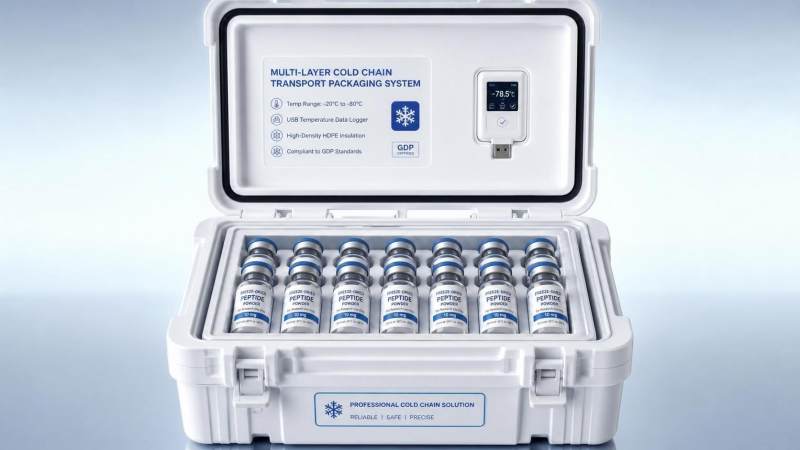
In biopharmaceutical development and life sciences research, many custom peptides possess intricate molecular structures that are highly sensitive to environmental thermal conditions. Severe temperature fluctuations during transit can lead to peptide degradation, folding anomalies, or a complete loss of biological potency. For a professional custom peptide manufacturer, achieving high-purity synthesis in the laboratory is only the beginning. Ensuring flawless cold-chain integrity across thousands of miles of international transit is the ultimate measure of an enterprise's supply chain capabilities.
1. Implementation of Advanced Lyophilization and Hermetic Sealing
Prior to dispatching any biological compound, pre-shipping stability optimization is paramount. Advanced manufacturing facilities utilize high-performance vacuum lyophilization (freeze-drying) protocols to convert synthesized peptides into stable, volatile-free powders. This amorphous or crystalline state significantly enhances the compound's inherent thermal resistance compared to liquid formulations. Following lyophilization, the peptides are instantly aliquoted into high-density, chemically inert vials or vials, which are then hermetically sealed under a vacuum or an anhydrous nitrogen blanket to permanently eliminate exposure to atmospheric moisture and oxygen.
2. Engineering of Multi-Layered Thermal Packaging Systems
International air freight exposes cargo to unpredictable climates and prolonged customs clearances. To mitigate these variables, a reliable peptide factory customizes its validation packaging based on the product’s specific storage parameters (typically -20°C, 2-8°C, or controlled ambient). The specialized shipping configuration comprises a multi-layered barrier system: a heavy-duty, impact-resistant corrugated outer carton; a thick, high-efficiency polyurethane (PU) or expanded polystyrene (EPS) thermal insulation chamber; and an internal core packed with precisely calculated volumes of dry ice blocks or ultra-low temperature phase-change material (PCM) gel packs. This configuration ensures that internal temperatures remain uniform throughout long-haul global corridors.
3. Integration of Continuous Temperature Data Logging
To provide international institutional buyers with definitive quality assurance, the entire logistics validation process must be completely transparent and verifiable. Professional manufacturers integrate single-use, calibrated USB temperature data loggers directly into the thermal core of the shipment. These sensitive components continuously log ambient conditions at strict intervals throughout the entire transit duration. Upon global delivery, the importing quality control team can seamlessly connect the logger to a terminal to retrieve an unalterable, comprehensive PDF or Excel thermal report. This diagnostic transparency ensures that the peptide's structural compliance is verifiable from the factory floor to the destination bench side.
4. Strategic Partnership with Qualified Global Cold-Chain Couriers
Maintaining thermal continuity requires seamless collaboration with top-tier international biopharmaceutical logistics integrators. Compliant peptide factories work exclusively with certified cold-chain couriers who offer prioritized customs clearance, dedicated airport ramp monitoring, and dry-ice replenishment capabilities at major international transit hubs. This active risk mitigation shortens custom wait times and ensures that even in the event of unforeseen flight delays, the shipment's thermal integrity remains uncompromised.