
Attending major international pharmaceutical ingredients exhibitions (such as CPHI) or biotechnology conventions (such as BIO) presents a highly efficient venue for global procurement managers to connect with custom peptide manufacturers. However, when faced with dozens of exhibitors, relying solely on sleek booth designs and glossy product catalogs is insufficient for evaluating a vendor's actual production scale and regulatory maturity. By leveraging the unique opportunity of face-to-face interactions on the exhibition floor, you can utilize a systematic verification framework to distinguish premier, technically proficient manufacturers from standard traders.
1. Verification of International Quality Management Credentials
Regulatory compliance serves as the primary screening threshold during on-site supplier evaluations. A qualified, trustworthy peptide factory should do more than verbally claim adherence to global standards—their representatives should be prepared to present or provide clear electronic evidence of their current quality management frameworks, such as ISO 9001 certifications. Sourcing managers should specifically inquire about the factory's history with international third-party audits and their capability to provide robust regulatory compliance documentation, which is crucial for mitigating cross-border customs bottlenecks and chemical importation risks.
2. Scrutinizing Raw Analytical Data and Technical Transparency
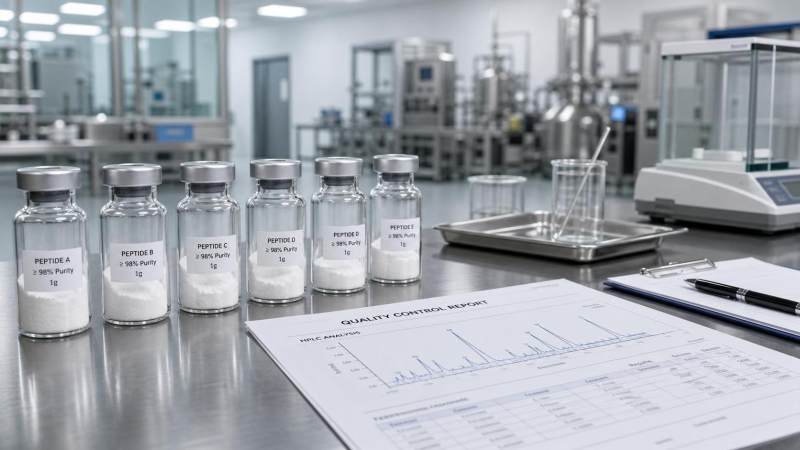
A manufacturer's true technical capability is written in their data transparency rather than their marketing copy. At the booth, ask the technical representatives to show sample analytical dossiers for their synthesized compounds. An advanced, high-quality peptide factory will readily share generic or standardized Certificate of Analysis (COA) portfolios featuring high-resolution analytical High-Performance Liquid Chromatography (HPLC) chromatograms and Mass Spectrometry (MS) profiles. Evaluating the baseline resolution, the containment of trailing impurity peaks, and the precision of molecular weight identification allows you to immediately gauge the sophistication of their purification chemistry and quality control platforms.
3. Assessing Practical Experience in Complex Modifications and Scaling Engineering
Exhibitions offer an unparalleled opportunity to consult directly with a factory’s senior chemical engineers. Rather than discussing generic lead times, steer the conversation toward highly specific technical parameters relevant to your pipeline. For instance, inquire about their optimized cyclization strategies for sequences containing multiple disulfide bridges, or ask how their process chemistry teams control epimerization and side reactions during a transition from milligram screens to pilot-scale kilogram scale-ups. A premier contract manufacturer will provide structured, practical insights into Solid-Phase Peptide Synthesis (SPPS) and Liquid-Phase Peptide Synthesis (LPPS) dynamics, proving their capacity to operate as a proactive R&D collaborator.
4. Evaluating Supply Chain Resilience and Logistics Protocols
Beyond chemistry, use the exhibition to audit the manufacturer's operational infrastructure. Discuss their localized raw material sourcing protocols, their production capacities across automated synthesizer suites, and their validated cold-chain shipping mechanisms for international air freight. A compliant factory will exhibit a clear, structured approach to supply chain resilience—including business continuity plans for environmental shutdowns and standard operating procedures for integrating temperature data loggers in overseas shipments. This operational readiness ensures that your commercial supply remains stable over multi-year lifecycles.