
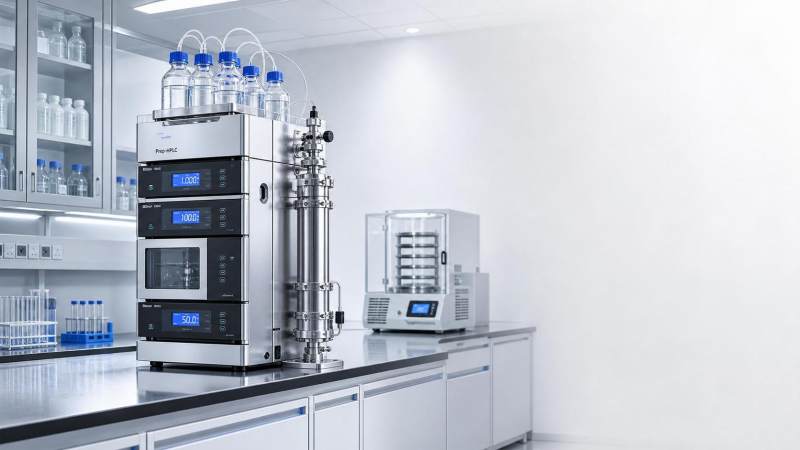
In the fields of chemical synthesis and pharmaceutical intermediates, the purity of peptides directly dictates their performance in downstream research, formulation development, and overall product stability. For procurement managers and R&D teams, partnering with a reliable source peptide factory that delivers consistently high-purity materials is paramount. But how exactly does a professional peptide manufacturer maintain high purity standards through comprehensive quality control (QC)?
1. Precise Process Control in Solid-Phase Peptide Synthesis (SPPS)
The production of high-purity peptides begins with advanced chemical synthesis methods. Leading manufacturing facilities utilize automated Solid-Phase Peptide Synthesis (SPPS) technology. During each amino acid coupling and deprotection step, automated systems strictly monitor reaction temperatures, residence times, and reagent ratios. This precise execution significantly reduces side reactions and minimizes the formation of impurities.
2. Preparative High-Performance Liquid Chromatography (Prep-HPLC) Purification
Once crude peptides are synthesized, they must undergo meticulous purification. Factories utilize Preparative High-Performance Liquid Chromatography (Prep-HPLC) systems to separate target molecules based on polarity differences. This step efficiently isolates crude mixtures, removing truncated or deletion sequences, and elevates the product purity to meet customer specifications (such as ≥95% or ≥98%).
3. Comprehensive Quality Analytical Testing & Mass Spectrometry Verification
Product quality relies not only on numeric purity values but also on correct molecular identity. Fully compliant peptide manufacturers perform High-Performance Liquid Chromatography (HPLC) for purity analysis alongside Liquid Chromatography-Mass Spectrometry (LC-MS) or MALDI-TOF for exact molecular weight and structural verification. Each batch is accompanied by a transparent Certificate of Analysis (COA).
4. Controlled Packaging, Lyophilization, and Storage Environments
High-purity peptides can be sensitive to environmental factors like moisture and heat. Professional facilities process final products within cleanroom environments, utilizing specialized lyophilization (freeze-drying) techniques and low-temperature storage protocols to prevent degradation or moisture absorption during handling and logistics.
By implementing an end-to-end quality management system—spanning raw material inspection, synthesis, purification, and final testing—source peptide factories provide global partners with stable, well-characterized peptide materials to support their research and industrial applications.